Three Rival Versions of Moral Enquiry by MacIntyre
MacIntyre's project, here as elsewhere, is to put up a fight against philosophical relativism. . . . The current form is the 'incommensurability, ' so-called, of differing standpoints or conceptual schemes. Mr. MacIntyre claims that different schools of philosophy must differ fundamentally about what counts as a rational way to settle intellectual differences. Reading between the lines, one can see that he has in mind nationalities as well as thinkers, and literary criticism as well as academic philosophy. More explicitly, he labels and discusses three significantly different standpoints: the encyclopedic, the genealogical and the traditional. . . . [T]he chapters on the development of Christian philosophy between Augustine and Duns Scotus are very interesting indeed. . . . [MacIntyre] must be the past, present, future, and all-time philosophical historians' historian of philosophy. -The New York Times Book Revie
Original: $1.22
-65%$1.22
$0.43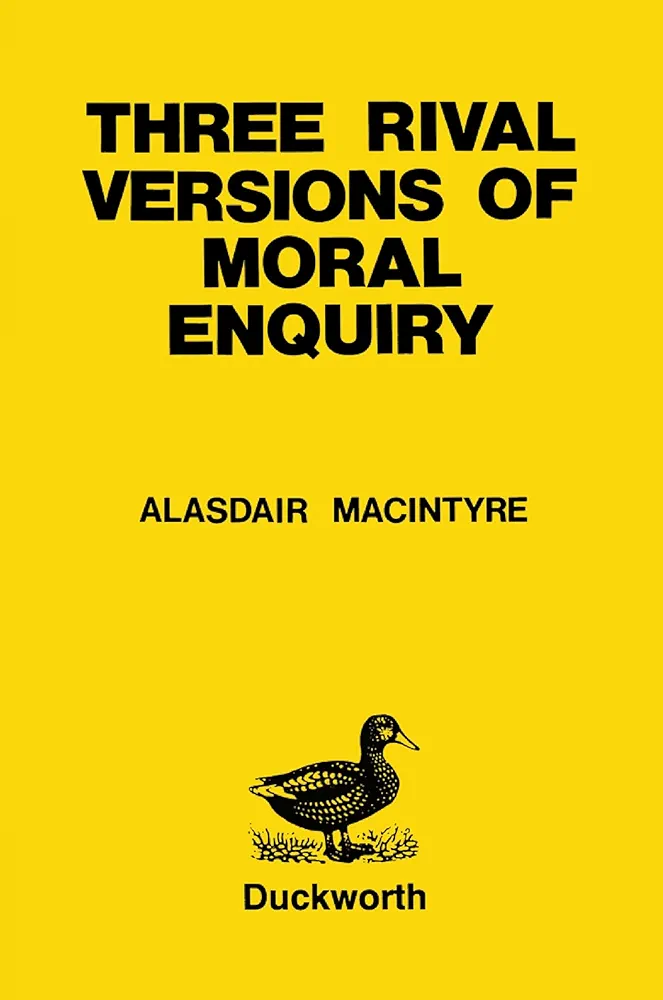
Description
MacIntyre's project, here as elsewhere, is to put up a fight against philosophical relativism. . . . The current form is the 'incommensurability, ' so-called, of differing standpoints or conceptual schemes. Mr. MacIntyre claims that different schools of philosophy must differ fundamentally about what counts as a rational way to settle intellectual differences. Reading between the lines, one can see that he has in mind nationalities as well as thinkers, and literary criticism as well as academic philosophy. More explicitly, he labels and discusses three significantly different standpoints: the encyclopedic, the genealogical and the traditional. . . . [T]he chapters on the development of Christian philosophy between Augustine and Duns Scotus are very interesting indeed. . . . [MacIntyre] must be the past, present, future, and all-time philosophical historians' historian of philosophy. -The New York Times Book Revie